
You’re Busy Every Night — So Where Did the Money Go?
The dining room is full. The kitchen is slammed. The servers can’t keep up. By any measure, tonight looks like a win.
But at the end of the month, when the invoices are paid and the payroll clears, the number in the bank account doesn’t match the energy that poured through that room. And it’s not a one-time thing. It keeps happening — month after month, season after season — until one day the owner sits down and realises they’ve been working a 60-hour week to basically break even.
This is not a rare story. According to a late-2025 survey by Restaurants Canada, 44% of Canadian restaurants were either losing money or simply breaking even — nearly four times the rate seen in 2019, when only 12% were in that position. And around 80% of Canadian restaurants currently carry some level of debt, with nearly two-thirds reporting it could take over a year to stabilise their finances.
The industry does over $96 billion in annual sales. It employs 1.2 million Canadians. And nearly half of its operators aren’t making money.
The reason, more often than not, isn’t the food. It isn’t the concept. It isn’t even the location.
It’s that most restaurant owners don’t actually know what their food is costing them.
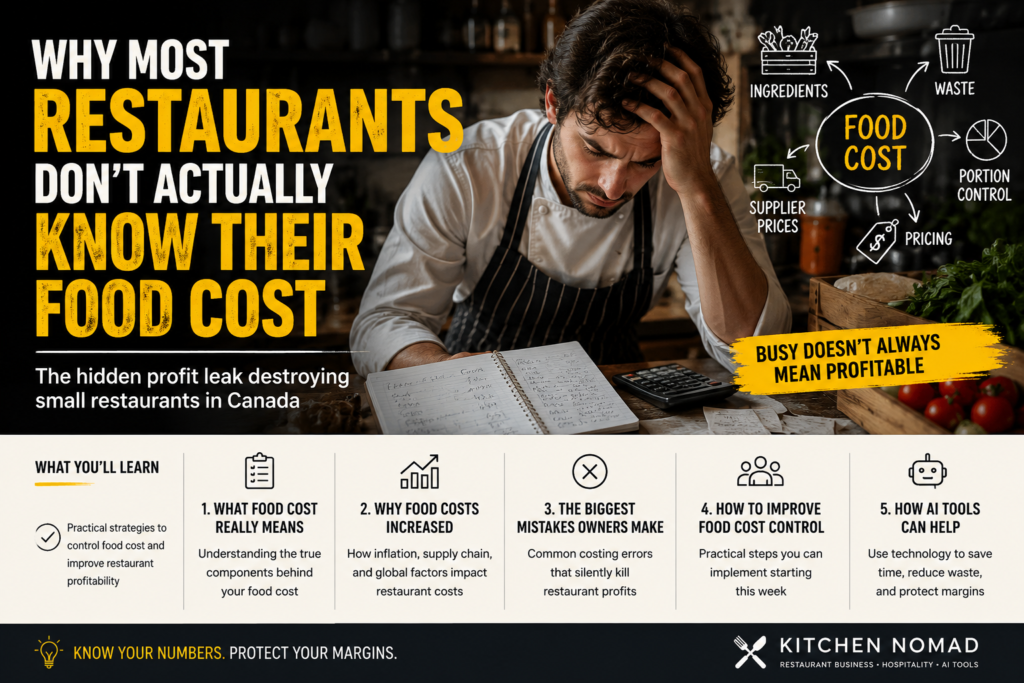
What Food Cost Really Means
When operators talk about food cost, they usually mean one thing: the percentage of revenue spent on ingredients. The industry benchmark is 28–35% — meaning for every dollar of food revenue, a well-run restaurant should be spending 28 to 35 cents on what goes on the plate.
But that single number hides a much messier reality, and conflating “ingredient cost” with “actual food cost” is where most operators go wrong.
True food cost includes:
Raw ingredient percentage — the base cost of the proteins, produce, and dry goods that go into a dish. This is the number most operators track, or at least attempt to.
Actual plate cost — what it costs to execute that specific recipe, including every component. Not just the chicken breast, but the marinade, the garnish, the sauce, the starch on the side. A recipe might have 14 ingredients, and operators often only track 3.
Waste — pre-consumer waste (trim, spoilage, prep loss) can easily add 3–8% to your actual food cost depending on the protein and the kitchen. A 10 kg case of salmon does not yield 10 kg of servable fish. Operators who aren’t tracking usable yield are working with distorted numbers from the start.
Oils, sauces, and condiments — these feel like rounding errors until you realise your kitchen goes through 20 litres of canola oil a week. Cooking oils in Canada saw prices rise over 13% in 2024 alone — a category that most recipe cost sheets don’t even have a line for.
Labour overlap — prep labour is not a “labour cost.” When your prep cook spends 3 hours breaking down cases of produce and butchering proteins, that time is inseparable from the cost of executing your menu. Separating it entirely from food cost creates a false picture of both.
The difference between what a dish should cost and what it actually costs — once you account for all of the above — is often 5 to 12 percentage points. In an industry where the difference between profit and loss lives in single digits, that gap is everything.
Why Food Costs Increased So Much After COVID
The post-pandemic period didn’t just bring higher prices. It restructured the entire cost architecture of the restaurant business.
Between 2020 and 2025, Canadian food prices increased by a cumulative 14.1%, with grocery-level inflation consistently outpacing overall CPI. Since 2022 alone, grocery prices have risen approximately 22%, while general consumer prices have risen roughly 13%. For restaurant operators buying in volume, the pain has been disproportionately concentrated in specific categories.
Fuel and logistics — The pandemic disrupted global freight systems at every level. Container shortages, port backlogs, and fuel surcharges became structural cost add-ons that suppliers quietly baked into invoices. Even as acute supply chain pressure eased in 2023, many of those costs never fully unwound.
Cooking oil — Edible fats and oils became one of the most volatile categories in the entire supply chain, with Canadian prices up 17.1% in 2023 and still rising 13.3% in 2024. For restaurants that fry, sauté, or finish sauces with fat, this is an enormous and undertracked cost.
Meat and protein — By December 2025, retail beef prices in Canada were 17% higher year-over-year, driven by domestic drought conditions, high feed costs, and tight cattle inventory. For restaurants where protein is the anchor of the plate, this alone can push food cost past 35% without a single menu change.
Dairy — Dairy inputs follow a regulated pricing structure in Canada, but they are not immune to volatility. Cream, butter, and aged cheese have all seen sustained price increases that make dairy-heavy menus progressively more expensive to operate.
Imports and the weakening Canadian dollar — Canada imports a significant portion of its processed food and certain produce year-round. When the Canadian dollar depreciated sharply in late 2024, the cost of everything imported rose with it. The Bank of Canada identified import costs as the primary driver of food inflation in 2025, with prices for imported processed food beginning to rise early in the year. For restaurants using specialty imports — olive oil, certain cheeses, out-of-season produce — the impact has been direct and immediate.
Canada’s Food Price Report 2025 forecasted overall food price increases of 3–5% for 2025, with the average family of four expected to spend $801 more on food than the year before. Restaurant operators are not families of four — they are purchasing at scale, on tighter margins, and without the flexibility to simply buy less.
The cost environment is not temporary. And operators who are still pricing their menus based on 2021 or 2022 ingredient costs are effectively subsidising their customers’ meals out of their own margins.
The Biggest Mistakes Restaurant Owners Make
Most food cost problems don’t come from bad luck. They come from habits that made sense when margins were healthier and that nobody ever stopped to examine.
Not raising menu prices
This is the most common and most financially damaging mistake in the Canadian restaurant industry right now. Menu price increases are psychologically uncomfortable — operators worry about losing customers, about pushback, about the appearance of greed. But the math is unambiguous.
If your food cost was 30% in 2020 and your ingredient prices have risen 14–22% since then without a corresponding menu price increase, your food cost percentage is now somewhere north of 36–40%. The 85% of Canadian restaurants that told Toast their 2025 operations were being challenged by inflation are not all struggling because of unusual circumstances. Many are struggling because their menu prices haven’t moved in three years.
A 10–15% price increase on select items, phased in gradually, is vastly less damaging than operating at a loss for another 12 months.
Portion inconsistency
A recipe card that says “180g of salmon” means nothing if every cook is eyeballing it. A 20g variance on protein — which is entirely normal in kitchens without weight-based portioning — translates directly into food cost variability. On a busy night of 150 covers, that variance adds up to kilograms of untracked cost. Multiply that across a week and you have a meaningful, preventable expense that never shows up on any invoice.
Not comparing suppliers
Most restaurants develop relationships with one or two suppliers and stay there indefinitely. The relationship has real value — reliability, credit terms, service. But the price list from that trusted supplier may be 8–15% higher than a comparable option, and operators who haven’t run a comparison in 12 months genuinely don’t know. With input costs this volatile, a quarterly supplier review is no longer optional. It’s margin.
High-popularity items with no real profit
This is the most insidious problem in menu engineering. A dish sells 60 units a night, the kitchen has it down cold, and the customers love it. It feels like a success. But if that dish has a food cost of 42% and a contribution margin of $4.50, it is generating less profit per cover than a moderately popular dish with a 32% cost and an $11 contribution margin.
Popularity and profitability are not the same thing. A restaurant can run a full dining room every night and still lose money if the sales mix is weighted toward high-volume, low-margin items. Menu engineering — the practice of classifying items as Stars, Plowhorses, Puzzles, or Dogs based on both popularity and contribution margin — exists precisely to solve this problem. Most operators either don’t do it at all, or do it once and never revisit it.
Why Busy Restaurants Still Lose Money
Volume is not a margin strategy.
A restaurant doing $80,000 in monthly revenue with a 38% food cost, 34% labour, 12% occupancy, and 8% in other overheads is running at a 92% total cost ratio. That leaves 8% — or $6,400 — to service debt, absorb equipment failures, build reserves, and call profit. In a bad month, that becomes 0%.
The belief that revenue solves everything is one of the most persistent and dangerous misconceptions in the hospitality industry. High revenue covers the symptoms. It does not cure the underlying condition.
When the dining room is full and the team is stretched, operators tend to defer the difficult decisions — renegotiating supplier contracts, retesting recipes for yield, rebuilding cost sheets after an ingredient substitution. The urgency always feels like it’s in the kitchen, not at the desk. And so the numbers drift.
What makes this particularly acute in Canada right now is the combination of sustained cost increases and softening consumer demand. Restaurant bankruptcies in Canada surged 30% in 2024, a year when the industry was still growing in total revenue. Operators were earning more and failing more at the same time. That is what happens when volume grows but margins are not managed.
How Restaurants Can Improve Food Cost Control
The good news is that food cost control is a systems problem, and systems can be fixed. None of the solutions below require expensive technology or a complete operational overhaul. They require discipline, consistency, and the willingness to look at the numbers honestly.
Weekly inventory counts
Operators who take inventory monthly are working with data that is three to four weeks old. In a volatile cost environment, that lag creates decisions based on conditions that no longer exist. Weekly inventory — even a simplified version focused on the top 10–15 cost items — provides meaningful insight into usage, variance, and waste patterns. It is the single highest-return habit in food cost management.
Smaller, more intentional menus
Every additional menu item carries hidden costs: ingredients that may not move fast enough, prep labour spread across more components, and cognitive load on the kitchen during service. Restaurants that have reduced their menus in response to cost pressure have generally found that it improves food cost percentage, reduces waste, and — counterintuitively — increases customer satisfaction through better execution. In the context of the current market, a focused menu with every item engineered for profitability outperforms a large menu every time.
Standardised recipes with costed portions
A standardised recipe is not a constraint on creativity. It is the mechanism by which a consistent food cost percentage becomes possible. Every menu item needs a documented recipe that specifies ingredient quantities by weight, accounts for usable yield on proteins and produce, and has a calculated cost per plate. This cost should be updated whenever a significant ingredient price changes — which, in the current environment, means at minimum quarterly.
Contribution margin analysis, not just cost percentage
Food cost percentage tells you the ratio. Contribution margin tells you the dollars. A dish with a 32% food cost that sells for $18 generates $12.24 in contribution. A dish with a 29% cost that sells for $12 generates $8.52. The first dish has a higher percentage but is doing far more work for the business. Decisions about what to promote, what to price up, and what to remove from the menu should be based on contribution margin, not cost percentage alone.
Quarterly supplier reviews
Contact at least two or three alternative suppliers annually for pricing on your highest-volume ingredients. You may not switch — but the knowledge that alternatives exist is a negotiating position. Suppliers who know their clients are price-aware tend to be more competitive on renewals.
Seasonal menu rotations
Seasonal ingredients are cheaper when they’re in season, and in Canada the seasonal swings are significant. Building quarterly menu updates around peak-availability produce — local asparagus in spring, stone fruits in summer, squash and root vegetables through fall — reduces input cost while also giving regular customers a reason to return. This is how fine dining restaurants routinely run lower food cost percentages than casual concepts despite using more expensive techniques.
How AI Tools Can Help Restaurant Operators
The strategies above are proven. They work. But they take time and attention that most operators running full service — hiring, managing, cooking, and owning simultaneously — struggle to protect.
This is where purpose-built tools are starting to change the equation.
AI-driven restaurant management platforms are now capable of analysing sales mix and flagging low-margin items before they become a pattern. Recipe costing software can automatically reprice menu items when supplier invoices update. Inventory systems can identify variance between theoretical and actual food cost, pointing directly to waste or portion drift. And predictive ordering tools can reduce over-purchasing on perishables, one of the most common and invisible sources of food cost leakage.
A recent Canadian industry survey found that 76% of restaurant operators see strong ROI potential in automation and technology, and 69% planned to increase technology spending in 2025. The shift is underway.
[For a deeper look at how AI tools are being applied to restaurant operations specifically — from menu engineering to inventory optimisation — see our earlier piece on AI in the restaurant industry.]
Restaurants No Longer Survive on Volume Alone
The model that sustained Canadian restaurants through the last decade — keep the dining room full, manage the top-line, trust that the costs will work themselves out — is no longer viable.
Food costs are structurally higher than they were pre-pandemic. Input volatility is not going away. Consumer spending is being squeezed from multiple directions. And the operators who are still running on instinct and habit, pricing menus the way they did three years ago and tracking food cost once a month if at all, are operating without visibility into what is actually happening to their margins.
The restaurants that survive the next decade will not necessarily be the ones with the best food or the most loyal following — though those things matter. They will be the ones where someone sat down, learned the numbers, built the systems, and treated food cost not as an accounting exercise but as the foundation of everything.
Understanding food cost, building real systems around it, and pricing for actual profitability rather than hoped-for volume: these are not advanced concepts. But in an industry where most operators still don’t know what their food is truly costing them, acting on them is a genuine competitive advantage.
Sources: Restaurants Canada (2025 member survey), CBC News, Toast Voice of the Canadian Restaurant Industry 2025, Statistics Canada CPI Annual Review 2024, Bank of Canada Sparks Article February 2026, Canada’s Food Price Report 2025 (Dalhousie University), IBISWorld Canada Food Price Index 2025, Made in CA Restaurant Statistics 2025, Doane Grant Thornton Canada Restaurant Analysis 2025.
Pingback: Why Delivery Apps Hurt Restaurant Profit Margins
Pingback: BC Restaurant Labour Costs in 2026: Why the Economic Structure Has Permanently Changed
Pingback: Why Canadians Are Eating Out Less in 2026