
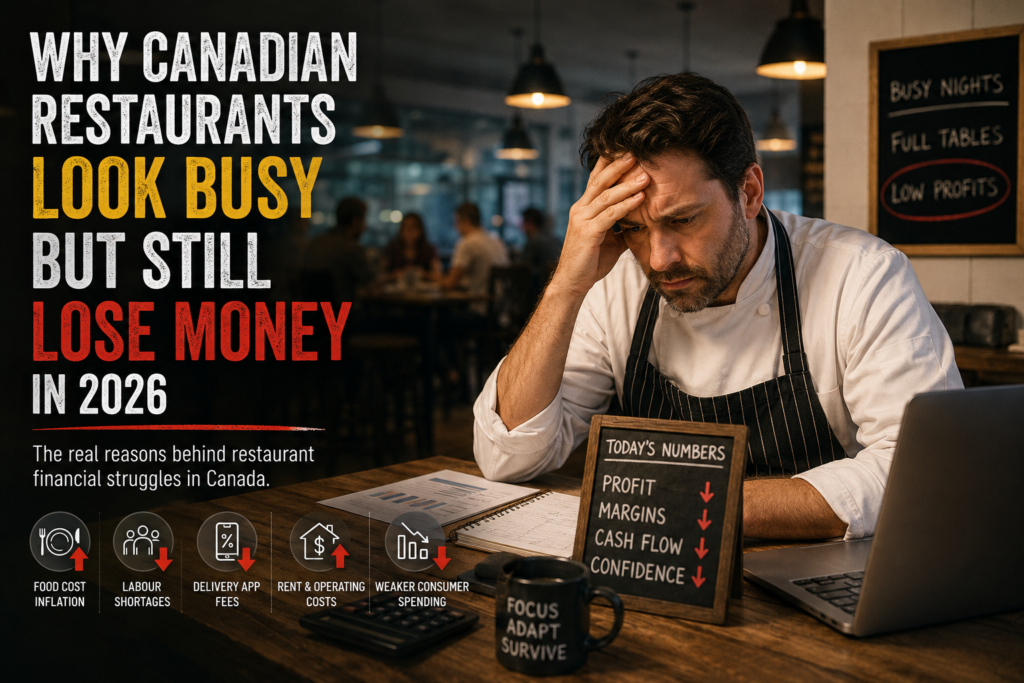
After the pandemic, many Canadian restaurants experienced a short recovery boom. Dining rooms became busy again, but rising operating costs quickly reduced profitability behind the scenes.
Canadian restaurants financial struggles have become one of the biggest challenges facing the hospitality industry in 2026.
As a chef and restaurant operator in Canada, I’ve personally seen how busy restaurants can still struggle financially behind the scenes.
Why Are Canadian Restaurants Struggling After the Pandemic?
The pandemic permanently changed the restaurant business in Canada.
Many restaurants survived COVID-19 shutdowns with the help of:
- government support programs
- emergency loans
- wage subsidies
- deferred rent agreements
However, once restaurants reopened, operators entered a completely different economy.
Instead of recovering slowly, restaurants were immediately hit with:
- higher food costs
- labour shortages
- fuel increases
- inflation
- supply chain instability
- rising interest rates
The post-pandemic recovery looked strong on the surface, but many restaurants were carrying significant financial pressure underneath.
Canadian Restaurant Industry Timeline: 2020 to 2026
2020: Shutdowns and Emergency Support
COVID-19 forced restaurants across Canada into survival mode.
Dining rooms closed, restrictions were introduced, and many operators lost most of their revenue almost overnight.
Government support programs helped many businesses survive temporarily, but debt quietly accumulated during this period.
Restaurants delayed:
- rent payments
- tax payments
- equipment financing
- supplier balances
Many businesses survived, but very few recovered financially during this time.
2021: Restaurants Reopen
When restrictions eased, customers returned quickly.
Restaurants became busy again, especially during patio season.
However, staffing shortages started appearing immediately.
Many hospitality workers had already left the industry during the pandemic, and restaurants struggled to rebuild teams fast enough.
Supply chain problems also started affecting operations:
- delayed shipments
- product shortages
- supplier inconsistency
- rising ingredient costs
2022: Food Cost Inflation Accelerates
Food cost inflation became one of the biggest problems in the hospitality industry Canada-wide.
Restaurants saw rapid increases in:
- meat prices
- dairy
- cooking oil
- vegetables
- seafood
- fuel costs
Russia’s invasion of Ukraine also created pressure on global grain and energy markets.
Many restaurant owners started raising menu prices, but supplier increases often moved faster than menu adjustments.
This significantly reduced restaurant profit margins.
2023: Interest Rates and Consumer Pressure
By 2023, consumers themselves were under financial stress.
Higher mortgage payments, grocery inflation, fuel costs, and debt pressure changed customer spending habits.
Many Canadians started:
- dining out less often
- spending less per visit
- avoiding premium menu items
- choosing cheaper restaurants
At the same time, restaurant operators faced:
- higher loan payments
- more expensive financing
- increasing labour costs
- higher insurance costs
2024: Busy Restaurants, Weak Profitability
One of the biggest misconceptions in the restaurant business Canada faced after COVID was that busy restaurants automatically meant profitable restaurants.
That was not always true.
Many restaurants looked successful because dining rooms were full, but financially they were struggling with:
- food cost inflation
- delivery app commissions
- labour cost increases
- rent
- utilities
- debt repayments
Many operators discovered that full dining rooms no longer guaranteed healthy profit margins.
Many restaurant owners now operate in an environment where sales alone are no longer enough.
Even busy restaurants may struggle with payroll, supplier invoices, rent increases, and debt repayments at the end of each month.
2025 to 2026: The New Restaurant Economy
By 2025 and 2026, many restaurant owners accepted that higher operating costs were no longer temporary.
This became the new normal.
The hospitality industry in Canada is now defined by:
- thinner margins
- cautious consumers
- expensive labour
- unstable supplier pricing
- economic uncertainty
Modern restaurant operations now depend heavily on financial discipline, operational systems, and careful cost control.
The Biggest Financial Problems Restaurants Face in Canada
Food Cost Inflation in Canada
Food cost inflation remains one of the largest financial challenges for Canadian restaurants.
Several factors continue affecting food prices:
- global conflict
- transportation costs
- weather disruptions
- fuel prices
- currency fluctuations
- supply chain instability
Many restaurants that previously operated with food costs around 28% to 30% now struggle to stay below 35%.
For many restaurants, maintaining stable margins has become increasingly difficult.
Labour Costs and Staffing Challenges
The labour costs that restaurants face today are significantly higher than before the pandemic.
Restaurants continue dealing with:
- wage increases
- staffing shortages
- burnout
- employee turnover
- training inconsistency
Hospitality culture also changed after COVID-19.
Many workers now prioritize:
- work-life balance
- flexible scheduling
- stable work environments
Restaurants without strong systems often struggle to keep experienced staff long-term.
Rent and Fixed Costs
Fixed costs are hurting many restaurants in Canada.
Even when sales remain stable, operators still face:
- commercial rent
- utilities
- insurance
- maintenance
- loan payments
- software subscriptions
These costs continue rising while restaurant profit margins remain thin.
Delivery App Commissions
Delivery apps helped many restaurants survive during the pandemic.
However, delivery platforms often charge commissions between 20% and 30%.
This creates a major profitability problem.
Delivery sales may increase total revenue while reducing actual profit.
Many restaurants now focus on:
- direct ordering systems
- loyalty programs
- email marketing
- repeat customers
to reduce dependence on third-party platforms.
Consumer Spending Pressure
Middle-income consumers across Canada are under pressure.
Housing costs, groceries, fuel prices, and debt payments continue reducing discretionary spending.
As a result, many customers now:
- dine out less often
- order fewer drinks
- skip appetizers
- choose lower-priced menu items
This directly affects restaurant sales and profitability.
Why Restaurant Owners Need Better Systems in 2026
The restaurant industry changed permanently after the pandemic.
Today, good food alone is not enough.
Modern restaurant operators must understand:
- food cost management
- menu engineering
- labour planning
- financial systems
- AI tools
- customer retention
- marketing strategy
Restaurants that survive long-term will likely be businesses that combine hospitality with operational intelligence.
How Restaurants Can Improve Profitability
The real challenge is protecting restaurant profit margins while operating costs continue rising every year.
Track Food Cost Weekly
Small increases compound quickly.
Weekly tracking allows operators to react faster before problems become severe.
Reduce Menu Complexity
Smaller menus improve:
- consistency
- inventory management
- labour efficiency
- food waste control
Focused menus are often more profitable.
Create High-Margin Menu Items
Restaurants should design menu items strategically instead of relying only on popularity.
High-margin dishes help stabilize restaurant profit margins.
Use AI Tools for Restaurant Operations
AI tools can help restaurant owners with:
- menu planning
- cost analysis
- scheduling
- marketing
- social media content
- customer communication
Technology is becoming increasingly important in modern restaurant operations.
Review Supplier Pricing Frequently
Restaurant owners should regularly compare supplier pricing and monitor purchasing trends.
Supplier increases can quietly damage profitability over time.
Avoid Excessive Discounting
Discounting may increase short-term traffic while hurting long-term profit.
Restaurants should focus on value rather than constant promotions.
Build Direct Customer Relationships
Direct customer relationships matter more than ever.
Restaurants should focus on:
- email lists
- loyalty programs
- repeat guests
- community engagement
This improves customer retention and reduces reliance on third-party platforms.
Control Labour Scheduling
Labour is one of the largest cost lines in any restaurant.
Scheduling based on habit or last week’s pattern is expensive.
Operators should use POS sales data to map revenue by hour and day, then build staffing levels that match actual demand — not assumption.
Matching your best team members to your highest-revenue shifts protects both service quality and labour efficiency.
Even small scheduling adjustments made consistently can meaningfully reduce weekly labour cost without cutting team hours unfairly.
Understand Contribution Margin
Revenue alone does not tell you whether your restaurant is actually profitable.
Contribution margin — the amount each menu item contributes after its direct food cost — is one of the most important numbers in restaurant finance.
Knowing which dishes cover the most cost per sale allows operators to:
- price menus more strategically
- identify which items are worth promoting
- remove dishes that look popular but actually drain margin
- make better purchasing and portioning decisions
Operators who track contribution margin by item make better decisions than those who look only at total sales.
You can also read our guide on how restaurant operators are using AI tools to improve restaurant efficiency, marketing, and cost control in 2026.
Final Thoughts on Canadian Restaurants Financial Struggles
Canadian restaurants financial struggles are not happening because operators suddenly stopped working hard.
Most restaurant owners are working harder than ever.
The problem is that the economic environment surrounding hospitality changed dramatically after the pandemic.
Food cost inflation, labour pressure, debt, rent, and weaker consumer spending created a difficult operating environment across the hospitality industry Canada-wide.
The future of the restaurant business in Canada will likely belong to operators who understand:
- food
- finance
- systems
- technology
- customer behaviour
Restaurants are no longer just kitchens.
They are operational systems that require constant adaptation.
Frequently Asked Questions
Why are restaurants struggling in Canada?
Canadian restaurants are struggling because of food cost inflation, labour shortages, rent increases, delivery app commissions, and weaker consumer spending after the pandemic.
What is a normal restaurant profit margin in Canada?
Most full-service restaurants in Canada operate with profit margins between 3% and 10%, depending on concept, labour cost, and operating efficiency.
How did COVID-19 affect restaurants in Canada?
COVID-19 created shutdowns, staffing shortages, debt pressure, and major operational changes across the Canadian restaurant industry.
Are delivery apps profitable for restaurants?
Delivery apps can increase sales volume, but high commission fees often reduce overall restaurant profitability.
Disclaimer: This article is based on general industry observation and personal experience and should not be considered financial advice.
Pingback: Why Most Restaurants Don’t Actually Know Their Food Cost
Pingback: Why Delivery Apps Hurt Restaurant Profit Margins
Pingback: Why Restaurant Owners Struggle to Understand Profit Margins
Pingback: BC Restaurant Labour Costs in 2026: Why the Economic Structure Has Permanently Changed
Pingback: Why Canadians Are Eating Out Less in 2026